
You’re Not Bad at Business — You’re Just Growing
If your business has grown faster than your financial systems, you’re not failing. You’re evolving.
Most business owners don’t make tax mistakes because they’re careless. They make them because they’re busy building, serving clients, managing teams, and saying “yes” to opportunities before their back-end has caught up.
If you’ve ever thought:
-
“I’m probably overpaying taxes, but I don’t even know where to start,” or
-
“I’ll deal with this later, after things slow down,”
You’re not alone. These are some of the most common small business tax mistakes, and they’re incredibly fixable.
This post is here to reduce anxiety, replace shame with clarity, and help you understand what’s really happening behind the scenes as your business grows.
Why Tax Mistakes Happen as Businesses Grow
Tax issues rarely show up when a business is brand new. They show up in the middle stage — when revenue increases, complexity grows, and DIY systems quietly stop working.
Growth brings:
-
More income streams
-
More expenses
-
More compliance requirements
-
More opportunities for tax savings and more opportunities to miss them
Without proactive planning, taxes become reactive, something you survive instead of strategically manage.
That’s when small business tax mistakes start compounding.
The Most Common Small Business Tax Mistakes (And Why They’re So Normal)
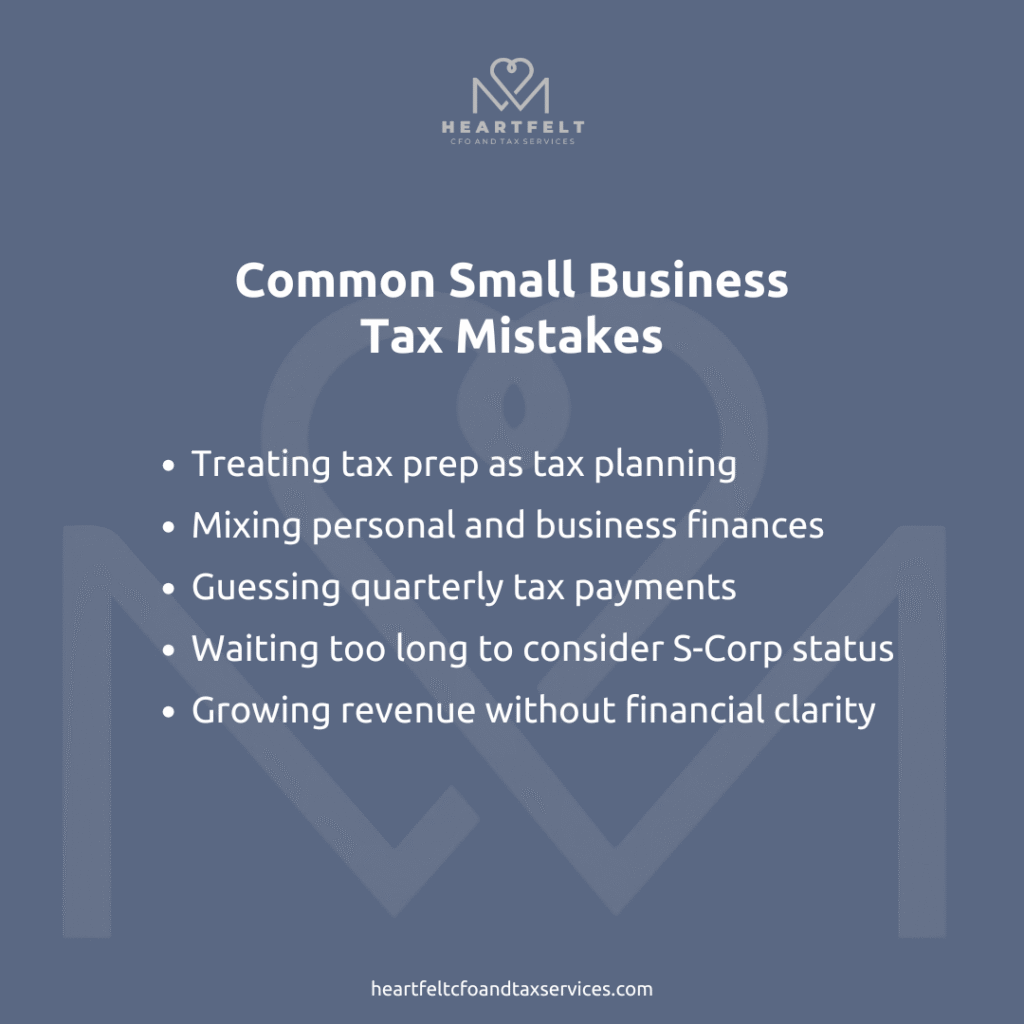
Mistake #1: Treating Tax Prep as Tax Planning
Many business owners believe:
“My accountant will tell me if something’s wrong.”
But traditional tax prep focuses on filing accurately, not minimizing future tax liability.
If your tax conversations only happen once a year, you’re likely:
-
Missing deductions
-
Paying higher effective tax rates
-
Making decisions blindly throughout the year
This is one of the biggest small business tax mistakes — and it’s incredibly common.
Mistake #2: Mixing Personal and Business Finances
This isn’t about being “messy.” It’s about being human.
When accounts aren’t clean:
-
Deductions get missed
-
Expenses get misclassified
-
Audit risk increases
-
Financial clarity disappears
Bookkeeping cleanup isn’t about perfection — it’s about trustworthy numbers.
Mistake #3: Waiting Too Long to Ask “Should I Become an S-Corp?”
Many growing businesses ask this question after they’ve already overpaid thousands.
S-Corp status can be powerful — but only when:
-
Revenue is consistent
-
Payroll is handled correctly
-
Compliance is maintained
Without guidance, businesses either:
-
Elect too early (and overcomplicate things), or
-
Elect too late (and miss major savings)
Mistake #4: Guessing Quarterly Tax Payments
If you’re:
-
Underpaying → penalties and stress
-
Overpaying → cash flow strain
Quarterly estimates should be intentional, not emotional.
This is where year-round tax planning makes a measurable difference.
Mistake #5: Assuming Growth Automatically Equals Profit
Revenue growth doesn’t guarantee:
-
Higher take-home pay
-
Better cash flow
-
Lower taxes
Without CFO-level visibility, it’s easy to feel successful on paper while silently leaking money.
The Heartfelt Framework: From Tax Confusion to Tax Confidence
This is the path we see work again and again:
Cleanup → Organization → Clarity → Planning → Proactive Growth
Step 1: Cleanup
Fix historical bookkeeping issues and reconcile accounts.
Step 2: Organization
Establish systems that work as the business grows.
Step 3: Clarity
Understand real profitability, cash flow, and tax exposure.
Step 4: Planning
Use that clarity to reduce taxes before the year ends.
Step 5: Proactive Growth
Make decisions confidently, hiring, investing, scaling, without tax surprises.
The “Doing Well But Stressed” Business Owner
Let’s say you’re running a service-based business doing $350K–$500K in revenue.
You’re booked. Clients are happy. But:
-
Taxes feel unpredictable
-
You’re afraid to spend money
-
You suspect you’re overpaying taxes
-
You avoid looking too closely at the numbers
After a bookkeeping cleanup and tax planning review, you discover:
-
Missed deductions
-
Inaccurate quarterly estimates
-
An S-Corp election could save tens of thousands annually
Nothing about your work changed.
Only your clarity did.
Why This Matters — Financially and Emotionally
Small business tax mistakes don’t just cost money.
They cost:
-
Peace of mind
-
Confidence in decision-making
-
Emotional energy
-
Trust in yourself as a business owner
Tax planning isn’t about loopholes.
It’s about self-care for your business.
When your numbers are clear:
-
Decisions feel lighter
-
Growth feels safer
-
Stress decreases
-
Confidence increases
Clarity creates calm.

Practical Next Steps You Can Take Now
You don’t need to fix everything today. Start here:
- Review the last 2 years of tax returns
Look for patterns, not perfection. - Assess your bookkeeping quality
If reports feel confusing, that’s a signal — not a failure. - Estimate this year’s tax exposure early
Not in December. Not in April. Now. - Ask the S-Corp question intentionally
With numbers, not guesses. - Decide what level of support you need
Cleanup? Planning? Ongoing CFO guidance?
You Don’t Have to Figure This Out Alone
If you’re reading this and thinking, “I finally understand what’s been off,” that’s the moment clarity begins.
If you need direction:
👉 Book a Meeting
We’ll help you understand where you are and what support makes sense next.
Book your discovery call
If you’re ready to take action:
👉 Buy a Package
Whether you need bookkeeping cleanup, tax planning, or ongoing CFO support — we meet you where you are.
You’re not behind.
You’re just ready for the next level of financial clarity.
And that’s leadership.