

Real Estate Financial Assessment: Stop Leaving Money on the Table
You’re building wealth through real estate. You understand cap rates, cash-on-cash returns, and the power of leverage. You know how to find properties, negotiate deals, and manage tenants.
But here’s the question that keeps real estate investors up at night:
How much money am I leaving on the table?
The Hidden Costs of Reactive Financial Management
Most real estate investors operate in one of two modes:
Mode 1: DIY everything.
You handle your own bookkeeping, file your own taxes, and hope you’re not missing anything critical. You’re saving money on professional fees, but you have no idea if you’re optimizing depreciation, structuring entities correctly, or timing exits strategically.
Mode 2: Year-end tax prep only.
You hand your accountant a shoebox (or a folder) of receipts in March and wait for them to tell you what you owe. By then, it’s too late to implement any real tax strategy. You’re stuck with whatever happened last year.
Neither approach is proactive. And in real estate, where tax strategy can make or break your ROI, reactive management is expensive.
Here’s what I hear constantly from real estate investors:
-
“I don’t know if I’m maximizing depreciation on my rental properties.”
-
“Should I be holding properties in an LLC, S-corp, or something else?”
-
“I’m not sure if a cost segregation study makes sense for my portfolio.”
-
“I want to do a 1031 exchange, but I’m worried about the timing and rules.”
-
“I’m scaling quickly, but my financial systems feel like they’re held together with duct tape.”
These aren’t minor concerns. They’re six-figure decisions disguised as administrative questions.
Clarity Is the First Step in Building a Path Forward
Before you can optimize your real estate tax strategy, you need to understand where you actually stand. Not just your gross rental income, but your:
True profitability per property
After depreciation, mortgage interest, repairs, property management, and all the other expenses, what are you actually netting?
Cash flow vs. tax liability
Are you generating positive cash flow but still paying too much in taxes because you’re not leveraging available deductions?
Entity structure efficiency
Are your properties held in the right legal structure to minimize liability and maximize tax savings?
Exit strategy positioning
If you sell a property tomorrow, do you know how to defer or minimize capital gains taxes?
Growth readiness
If you want to acquire your next property, do you have the financial visibility to know if you can afford it—and how to structure the deal tax-efficiently?
That’s where clarity becomes power. And it starts with asking the right questions.
We Built This Assessment from Years of Real Client Conversations
This isn’t a generic real estate quiz. It’s a carefully crafted assessment built from years of working with real estate investors—from single-property landlords to multi-property syndicators, from house flippers to commercial property owners.
I’ve seen what separates investors who build sustainable wealth from those who chase deals without a strategy. I know the questions that reveal where tax savings are hiding. And I’ve distilled that knowledge into an assessment that gives you actionable insights specific to your situation.
This assessment asks the important questions:
-
Are you tracking profitability per property, or just overall portfolio revenue?
-
Do you have a depreciation strategy, or are you using the IRS defaults?
-
Are you structured to protect your personal assets from property-related liability?
-
Do you know your effective tax rate on rental income, and whether you’re in the right entity structure to minimize it?
-
Are you planning for eventual exits—or will you be caught off-guard by capital gains taxes when you sell?
These are the questions that separate reactive tax filing from proactive wealth-building. And they’re exactly what you’ll walk through in our Real Estate Financial Assessment.
Knowledge Is Power—and Action Starts Here
The difference between a CPA and a CFO is this: a CPA files your taxes based on what already happened. A CFO helps you structure your investments, plan your exits, and optimize your tax strategy before decisions are made.
This assessment is your first step toward that proactive approach. It takes about 10 minutes to complete, and at the end, you’ll receive:
-
A personalized analysis of your current financial and tax positioning
-
Specific recommendations based on your property type and investment strategy
-
Actionable next steps you can implement to improve your tax efficiency and profitability
-
Benchmarking insights so you can see how your portfolio stacks up against other investors in similar markets
No sales pitch. No pressure. Just clarity and a roadmap for what comes next.
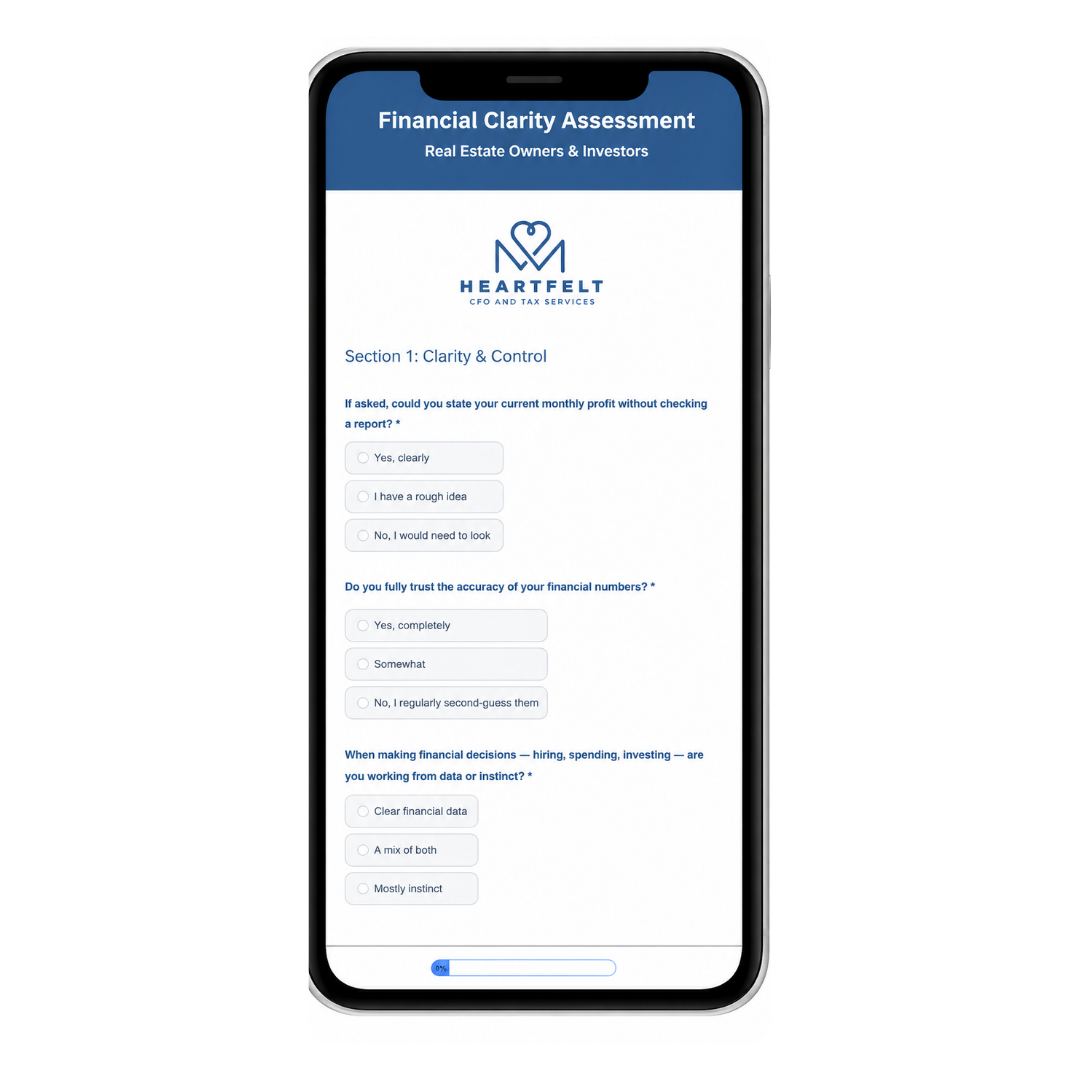
Take the Assessment Today
You didn’t get into real estate investing to overpay on taxes or miss opportunities. You got in to build wealth, generate cash flow, and create financial freedom.
The assessment is free, confidential, and designed specifically for real estate investors. Whether you own one rental property or a multi-million-dollar portfolio, you’ll get insights that are relevant to where you are right now.
Take the Real Estate Financial Assessment:
https://assess.heartfeltcfoandtaxservices.com/real-estate
Want to explore assessments for other industries or business models? Visit our full assessment library:
https://assess.heartfeltcfoandtaxservices.com
Because clarity isn’t just the first step—it’s the foundation for smarter investing, better tax strategy, and building real wealth through real estate.
About Heartfelt CFO & Tax Services
Margo Masri founded Heartfelt CFO & Tax Services to provide proactive financial strategy for business owners and investors who’ve outgrown traditional CPA services. Serving clients across New York, New Jersey, and nationally through virtual advisory, Heartfelt specializes in embedded CFO partnerships for industries including real estate, mental health, healthcare, construction, and professional services.