Fractional CFO” has become a widely used term — but for most business owners, it’s still a bit fuzzy. You’ve heard it mentioned at a networking event, maybe seen it come up when searching for financial help. You’re not entirely sure whether it’s something you need, whether it’s affordable, or frankly, what one actually does day to day.
That’s a reasonable place to be. The term gets used loosely, and there’s genuine variation in how different providers define and deliver the service. This article is meant to cut through the ambiguity and give you a clear, practical picture of what fractional CFO services actually look like — what gets done, how it differs from bookkeeping and accounting, and how to know whether it’s the right stage for your business.
Let’s Start With What It’s Not
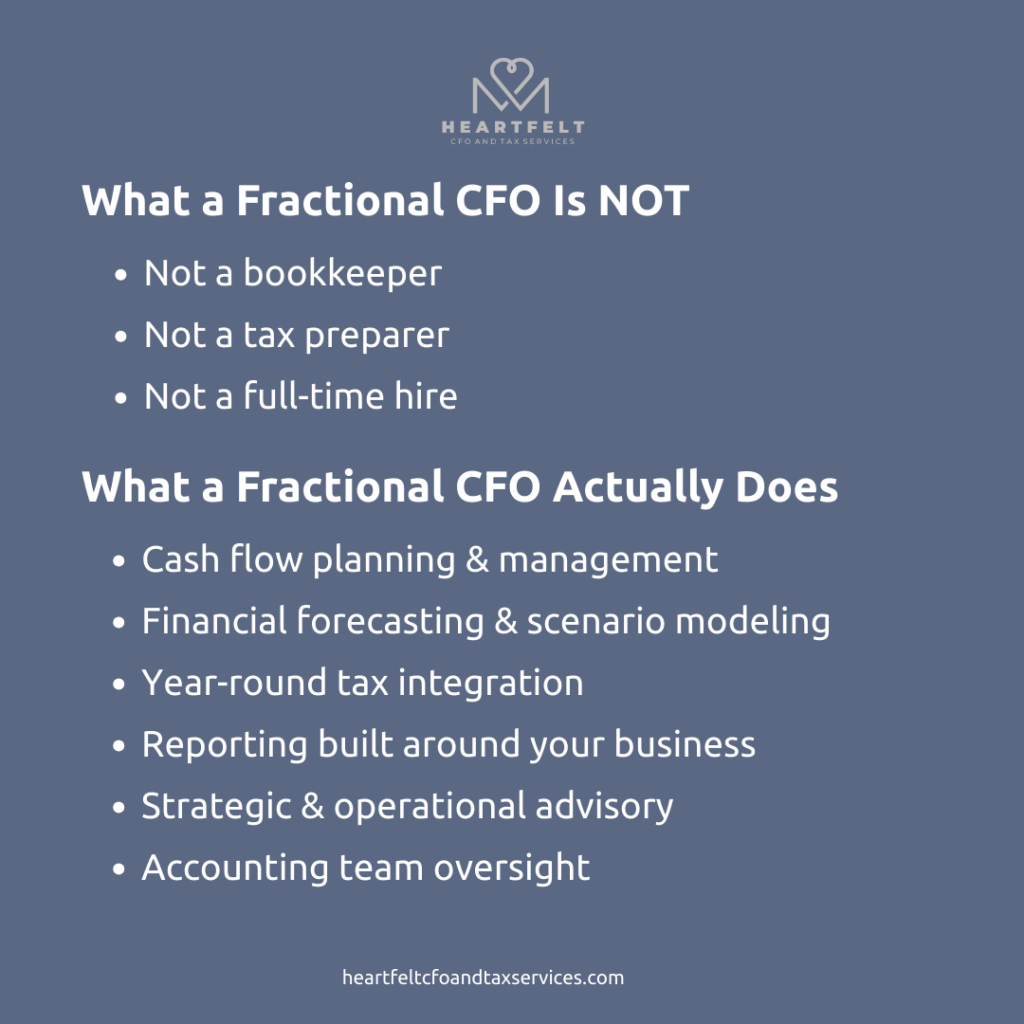
Before explaining what a fractional CFO does, it helps to be clear about what it isn’t — because there’s a lot of confusion here.
It’s Not Bookkeeping
Bookkeeping is the recording of financial transactions. It’s operational and backward-looking. Your bookkeeper (or bookkeeping service) ensures that every dollar in and out of the business is captured, categorized, and reconciled. That’s essential — but it’s not strategy.
A fractional CFO works with the output of good bookkeeping and financial reporting, but they don’t do the bookkeeping themselves. Think of it as: bookkeeping produces the data; the CFO interprets and acts on it.
It’s Not Tax Preparation
Tax preparation is the process of organizing your financial information and filing your returns accurately. Your CPA or tax preparer owns this.
A fractional CFO coordinates with your tax professional — ensuring business decisions are being made with tax consequences in mind — but is not the one submitting your returns. The CFO brings the tax strategy layer; the CPA handles execution and compliance.
It’s Not a Full-Time Hire
A fractional CFO works with your business on a part-time or project basis — typically anywhere from a few hours a month to two days a week, depending on the stage and complexity of the company.
You’re paying for senior financial expertise at a fraction of what a full-time CFO would cost (typically $250,000 to $400,000+ annually in salary and benefits for a qualified hire). For most growing businesses, that full-time model doesn’t make economic sense — but the gap in financial leadership is real and costly.
So What Does a Fractional CFO Actually Do?
The short answer is: they provide the financial leadership and strategic thinking that helps your business make better decisions, manage risk, and grow with intention.
The longer answer is a set of specific functions that most growing businesses don’t have covered.
Cash Flow Planning and Management
Cash flow problems kill profitable businesses. It happens more often than people realize — a company is billing well, growing steadily, and then suddenly can’t make payroll or cover a tax payment because revenue timing and expense timing don’t align.
A fractional CFO builds a rolling cash flow model that projects your inflows and outflows over a 13-week or 12-month horizon. This model gets updated regularly — weekly or monthly depending on the business — and becomes the tool you use to anticipate problems rather than react to them.
It answers questions like: when will we have enough cash to hire that person we need? Do we need to accelerate collections before Q4? What does our runway look like if a major client delays payment?
Financial Forecasting and Scenario Modeling
A forecast is not a budget. A budget tells you what you planned to spend. A forecast tells you what’s likely to happen based on current trends, and what different decisions would mean for the business.
A fractional CFO builds financial models that let you evaluate decisions before you make them.
-
If you’re considering adding a new service line, how does that affect your margins?
-
If you bring on three more employees, what does your break-even look like?
-
If your biggest client leaves, what’s your runway?
These are the questions that deserve real financial analysis, not gut instinct — and they’re exactly what scenario modeling is designed to answer.
Tax Integration and Year-Round Planning
One of the most valuable things a fractional CFO does is ensure that your business decisions and your tax strategy are connected — not running in parallel with occasional intersections at tax time.
This means the CFO is coordinating with your CPA or tax advisor throughout the year:
-
Flagging when a large purchase should happen before year end
-
Reviewing whether a distribution should be structured as salary or a draw
-
Advising on retirement account contributions
-
Making sure your entity structure is still working as the business grows
The goal is that by October or November, you have a clear picture of your approximate tax liability for the year and have already made the decisions that keep it as low as legally possible.
Financial Reporting That’s Actually Useful
Most small and mid-sized businesses receive monthly financial reports — a profit and loss statement, a balance sheet, maybe a cash flow statement — and don’t fully use them. The numbers are technically accurate but not translated into meaning.
A fractional CFO redesigns your financial reporting around the metrics that actually drive decisions in your specific business.
-
Service firm: revenue per employee, utilization rates, client concentration
-
Product business: inventory turns, contribution margin by SKU, return on ad spend
The CFO identifies what matters for your model and builds reporting that surfaces it clearly every month.
Operational and Strategic Advisory
Perhaps the most underrated function of a fractional CFO is the advisory role — being a financial thought partner for the business owner.
This looks different depending on the business, but common examples include:
-
Evaluating a new vendor contract and modeling the cost over time
-
Reviewing a potential partnership or acquisition opportunity
-
Advising on pricing changes and their impact on margins
-
Helping prepare for a bank meeting, line of credit application, or investor conversation
-
Assessing whether to lease or buy equipment or space
This is the work that rarely gets done in a growing business because there’s no one whose job it is to do it. The owner ends up making these decisions with incomplete financial information — or doesn’t make them at all because the analysis feels overwhelming. A fractional CFO fills that gap.
Accounting Team Oversight
In many engagements, the fractional CFO provides leadership and quality control over the existing accounting function — reviewing the work of a bookkeeper or internal accountant, ensuring month-end close is done correctly and on time, and escalating any issues.
This is especially valuable for business owners who don’t have the financial background to evaluate whether their books are being handled well. If you’re relying on a New Jersey-based accounting team such as Essex County Accounting and Tax, a fractional CFO can oversee that relationship to ensure consistency between reporting and strategy.
How This Differs From What Your CPA Does
The most common question we get is:
“I already have a CPA — do I need both?”
The honest answer is: it depends on what your CPA is doing and what your business needs. But in most cases, yes — because the roles are complementary, not redundant.
Your CPA’s job is to ensure that your financial history is accurately reported and that your tax filings are correct and timely. That’s a compliance function. It’s critical and valuable — but it is almost entirely backward-looking.
A fractional CFO’s job is to help you make better financial decisions going forward. The work is forward-looking, operational, and strategic.
The CFO doesn’t replace your CPA — they work alongside your CPA, using the CPA’s output as an input into ongoing strategic decision-making.
Many of our clients maintain their existing CPA relationships unchanged. The fractional CFO adds a layer that didn’t exist before — not a competing one.
What Stage of Business Is This For?
Fractional CFO services make the most sense for businesses that have moved past the early startup stage but haven’t yet scaled to the point where a full-time CFO hire is justified.
Generally, that means:
-
Annual revenue between $500K and $10M
-
At least a few employees or contractors and meaningful operational complexity
-
A business owner who is making strategic financial decisions regularly — not just tracking transactions
-
A desire to grow intentionally rather than reactively
It also makes sense for businesses going through a specific transition: preparing for a bank conversation, adding a new service line, bringing on a partner, or navigating a period of rapid growth that has outpaced the existing financial infrastructure.
What This Looks Like Month to Month
To make this concrete, here’s a typical monthly rhythm for a fractional CFO engagement with a growing professional service firm:
-
Week 1: Review prior month financials from bookkeeping; update cash flow forecast; flag any variances from projections
-
Week 2: Monthly check-in call with owner — review key metrics, discuss upcoming decisions, address any operational or strategic questions
-
Ongoing: Monitor estimated tax obligations; coordinate with CPA on planning items; review any contracts, hires, or major purchases being considered
-
Quarterly: Full financial review; update annual forecast; assess whether the business is on track and what adjustments to make
It’s structured, but it’s also responsive. If something significant happens in the business — a big new client, a key employee departure, an unexpected expense — the CFO is part of the conversation about what that means financially and what to do about it.
So Now What?
What You Should Do With This Information
If you’ve been running your business without this kind of financial oversight and you’re at the stage where it matters, the most useful thing you can do is have a clear-eyed look at what you don’t currently have visibility into.
Start here:
-
Can you say with confidence what your cash position will look like 90 days from now? If not, that’s a gap.
-
When you made your last significant business decision — a hire, a purchase, a pricing change — did you model the financial impact first? If not, ask yourself what that decision actually cost or saved you.
-
Is your tax strategy something that’s been discussed intentionally this year, or is it something you’ll find out about in April? If the latter, Q2 and Q3 are still ahead of you — it’s not too late to course correct.
These aren’t trick questions. They’re the starting point for understanding whether fractional CFO services are the right next step for where your business is right now.
Schedule a Complimentary Tax and Accounting Strategy Discovery Call — Book Your Call Here